What is lesion network mapping?
Lacuna characterizes a lesion by contextualizing it against several kinds of normative reference data. Lesion network mapping is one family of methods within that broader characterization. This page explains the idea.
A brain lesion's consequences depend not only on the tissue it destroys, but on the wider network that tissue belonged to. Two lesions of similar size in different locations can produce similar symptoms — because they map to the same network. Lesion network mapping is the family of methods that makes this network context explicit.
The core idea is to take an individual lesion mask and look it up in normative brain data — connectivity measured in large samples of healthy people — to infer which circuits the lesion engages. Because the connectivity comes from a normative reference rather than the patient, the method works even when you only have a lesion mask derived from anatomical images and no functional or diffusion imaging of the patient.
The types of lesion network mapping implemented in Lacuna
Functional lesion network mapping (FNM)
Which functional circuit is connected to the lesion site? Lacuna takes the lesion mask as a seed and computes its resting-state functional connectivity to the rest of the brain, using a normative functional connectome (e.g. GSP1000). The result is a whole-brain map of the functional network linked to the lesion. This functional variant is what the unqualified term lesion network mapping most often refers to in the literature.
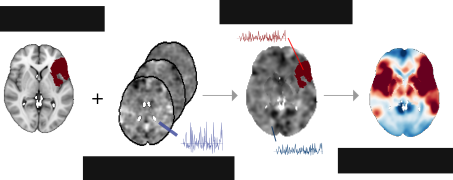
For further reading, see Fox et al., 2018, Boes et al., 2015, and Siddiqi et al. 2021.
Structural lesion network mapping (SNM)
Which white-matter connections does the lesion disconnect? Instead of functional correlation, SNM uses a normative tractogram (e.g. HCP1065 or dTOR985) to find the streamlines that pass through the lesion, yielding a map of structural disconnection. SNM additionally requires MRtrix3. This structural variant is also known as disconnectome mapping or disconnectivity mapping.
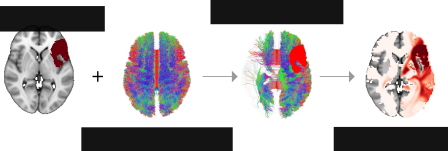
For further reading, see Thiebaut de Schotten et al., 2020, Salvalaggio et al., 2020 and Talozzi et al., 2023.
Accelerated functional network mapping (AFNM)
This answers the same question as FNM but with a faster, matrix-based implementation built on a parcellated functional connectome. It trades the full voxel-resolution map for substantially lower compute and memory cost.
Use it when you are processing many subjects and a parcel-resolution functional map is sufficient; use the standard FNM when you need voxel-level detail.
For further reading, see van den Heuvel et al., 2026.